
By John Cedrick Lomboy, Program Officer
For farmers in Barangay Laiban, Tanay, Rizal, agriculture is both a source of livelihood and a means of putting food on the table. Yet rising production costs, changing weather patterns, and limited access to sustainable farming knowledge pose challenges to their productivity and household food security.
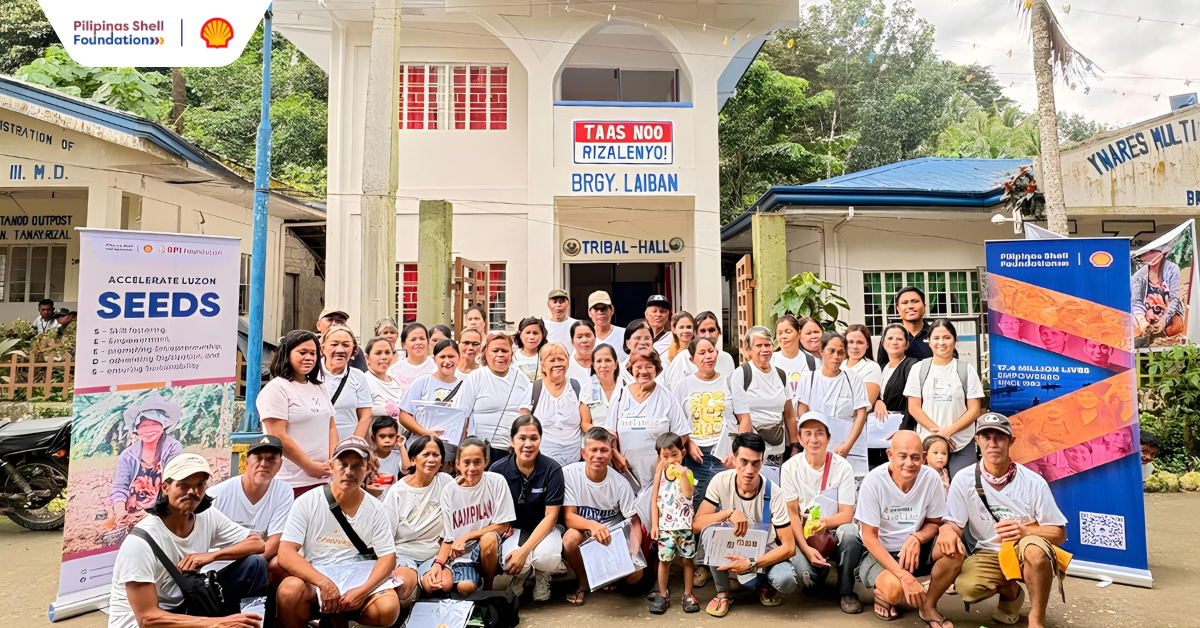
To help address these challenges, Pilipinas Shell Foundation, Inc. (PSFI), through its Accelerate Luzon SEEDS Program, conducted the second batch of the Integrated Farming Bio-System (IFBS) Training on September 8–10, 2026. The three-day activity equipped 41 farmers with practical knowledge and techniques to support more sustainable food production and resilient livelihoods.
The second batch followed an earlier training attended by 35 participants, bringing the total number reached to 76 farmers in Barangay Laiban, including members of the Dumagat-Remontado Indigenous Peoples community.
Participants came from Sitio Ibucao, Sitio Old Laiban, and Barangay Laiban Proper. Most were Dumagat-Remontado community members, including women and youth farmers who rely on agriculture for food and income.
Practical skills for farms and backyards
The training introduced IFBS as an approach that brings together different farming activities to make better use of available resources. Through discussions and hands-on demonstrations, participants explored techniques they could adapt to their farms and household gardens.
Topics covered organic vegetable production, container gardening, soil fertility management, composting, integrated pest management, and small livestock integration. Participants also learned basic farm planning and record-keeping, alongside the preparation of natural farming inputs such as Fermented Plant Juice (FPJ), Fermented Fruit Juice (FFJ), and Fish Amino Acid (FAA).

The practical sessions gave farmers opportunities to try these methods themselves, connecting the lessons to the resources and conditions in their own communities.
For participant Ruel Sasalo of Barangay Laiban, learning how to prepare their own fertilizer was a valuable takeaway. He shared that this was new knowledge for them and could offer a more affordable option for their farming needs.
His experience reflects one of the training’s intended benefits: helping farmers manage production costs by making use of locally available materials.
Supporting community self-sufficiency
PSFI’s Accelerate Luzon Team facilitated the activity with Lead Trainer Noah Portuguez and technical support staff John Cedrick Lomboy and Lorenzo Jacinto Jr. Program Excellence Unit Head Jonalyn Jackaria supported program monitoring and documentation.
The initiative forms part of the SEEDS Program, which stands for Skill Fostering, Empowerment, Promoting Entrepreneurship, Advancing Digitization, and Ensuring Sustainability. Through skills development and practical support, the program aims to strengthen communities’ capacity for long-term self-sufficiency and economic resilience.
As participants apply what they have learned, the program aims to help them improve household food supply, diversify farm products, reduce dependence on chemical inputs, and explore additional income opportunities. Its longer-term goals include establishing IFBS model farms that can serve as learning sites for other community members.
For the farmers of Laiban, completing the training marks a step toward putting sustainable practices into action. By supporting their knowledge and capabilities, PSFI seeks to help strengthen local food systems and expand livelihood opportunities within the Dumagat-Remontado community.